Tag: low code

A cooperative bank faces the same regulatory obligations as a large commercial bank: the same requirements imposed by the Polish Financial Supervision Authority (KNF) and the same expectations when it comes to audits and inspections. The difference lies in the resources available. A large bank can address these obligations with sophisticated IT systems developed over many years. A cooperative bank is more likely to rely on Excel spreadsheets, paper registers, and the good memory of individual employees. The obligations are similar, but the budgets are usually very different. A low-code platform does not have to solve all of these problems at once. It works particularly well where there is a need for a small, targeted application that does not replace the core banking system, but instead closes a specific gap alongside it. Such an application can typically be implemented in weeks rather than months, while the cost may be comparable to the annual cost of a single full-time employee rather than a major investme...

Monthly settlements for doctors and specialists often seem like a straightforward process. After all, all you need to do is count the services provided and calculate the compensation due. In practice, healthcare organizations operating across multiple facilities know that it is rarely that simple.  Every appointment, procedure, or hour worked by a specialist involves a series of administrative activities: recording the service provided, assigning the appropriate rate, verifying the data, approving the settlement, and, in the case of B2B cooperation, also handling accounting documents.  At a single facility with a small number of employees, such a process can be managed manually. The problem arises as the organization grows. When an organization works with numerous doctors and specialists across different locations, the number of data points, dependencies, and exceptions can quickly increase.  At that point, it becomes clear that the biggest challenge is not calculating the compensation itself. The real...
On 16–17 September, we invite you to Warsaw for the Cooperative Banking Leaders Forum. Two days of presentations and discussions on technology, regulations, and the future of local banking lie ahead. VSoft will be represented by Paweł Skawiński, who specializes in low-code solutions for the banking sector. We understand the challenges cooperative banks face: limited budgets, small teams, and a long list of changes to implement — while every modification to the core banking system comes with additional risk. This is exactly where our low-code platform comes in. It works alongside your existing banking systems, not instead of them. It communicates via APIs and does not require you to rebuild your existing architecture. Here are some of the areas where we see VSoft archITekt delivering value to cooperative banks today:Document generation. Generate documents at scale from templates and integrate this capability exactly where you need it, without a full platform implementation. Automatic mapping of banking...
During the GigaCon “IT in Banking” conference (21 May), Paweł Skawiński demonstrated how the low‑code approach is redefining the architecture of banking systems. The focus was placed on processes, decision models and algorithms, which are increasingly taking over the role of traditional code. The presentation delivered three key takeaways relevant to any financial institution aiming to respond faster to market changes while maintaining system stability and security. 3 key takeaways from GigaCon “IT in Banking” The process becomes the new codeThe era of embedding business logic in thousands of lines of code is coming to an end. Instead, business changes are moved directly into graphical process models and decision rules.This approach simplifies system architecture, improves transparency, and significantly shortens the time required to implement changes.The process is no longer just documentation — it becomes an active and executable component of the IT system.  Business regains real influence ...
On June 23–25, 2026, we will take part in IT Manager of Tomorrow in Gdynia — the largest event for technology leaders in Europe, bringing together AI, modern leadership and real‑world IT challenges. As an event partner, we invite you to visit our booth and attend our session: The Engine of Innovation and the Cost of Naivety. How to Become Data‑Driven in an AI‑Driven World Speakers:Radosław Majer – b2berryPaweł Skawiński – VSoft During the session, we will revisit AI and system architecture predictions made three years ago and confront them with current data and real examples from the Polish market. We will talk openly about the true cost of AI, growing system complexity, board‑level pressure to “implement AI,” and the increasing importance of data security — without buzzwords and without sugar‑coating. Key highlights of IT Manager of Tomorrow 2026 IT Manager of Tomorrow is designed as a practical forum where technology leaders can validate dec...
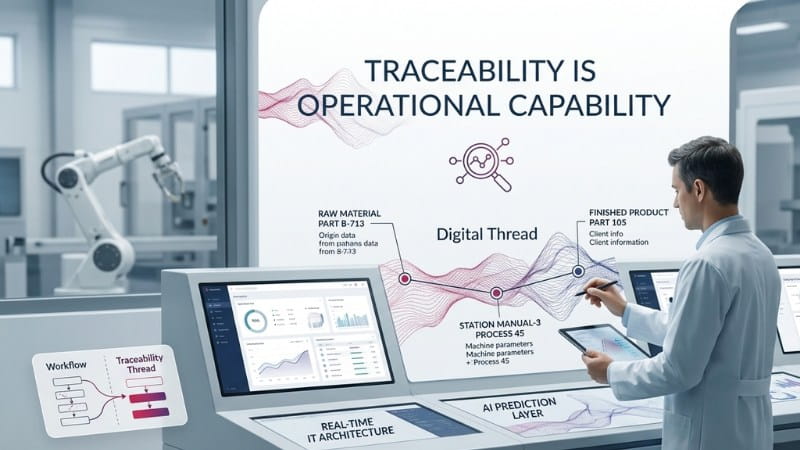
The need for full traceability in a modern manufacturing plant is a given today. However, statistics are ruthless: many projects in this area end at the concept stage or drag on for months, generating huge costs. Why does this happen? The reason is simple: traceability is not an "IT system" you buy off the shelf. It is a key operational capability of your plant. Trying to "squeeze" advanced production tracking into the rigid framework of standard IT systems is like trying to haul coal in a race car – technically it's a vehicle, but it wasn't built for that. Traceability is not workflow – it’s about working with dataMany manufacturers make a fundamental mistake at the start – treating traceability as just another business process requiring a "workflow." They try to build solutions based on simple forms, document flows, and notifications. This is a dead end. Traceability is not about handling decision flows. Traceability is data engineering. Production generates huge amounts of data: real-time mach...
During the GigaCon IT in Banking conference, Paweł Skawiński will deliver a presentation titled “Low-code in Banking: Architecture Based on Processes, Models and Algorithms.” The presentation will focus on a modern approach to building banking systems, where traditional programming is replaced by an architecture based on processes, data models, and business-defined algorithms. It will demonstrate how low-code platforms help reduce implementation time and limit dependency on traditional hard-coding. During the session, a system development methodology based on three key pillars will be presented:graphical modeling – designing business processes using visual components without implementing logic directly in code,process algorithms – building decision paths and business logic by business analysts, with the ability to validate them without developer involvement,agile UI approach – generating multichannel user interfaces based on data models and process flows. The presentation will focus on the prac...
On April 14, 2026, the Institute of Mother and Child published a report summarizing the 4th edition of the Mother and Child Startup Challenge (MCSC) and the MCSC Hospital Leadership Innovation program – one of Poland's key initiatives dedicated to innovation and healthcare management. The report focuses, among other things, on the efficiency of hospital management, IT system interoperability, and the role of data in decision-making. The publication is available free of charge to anyone interested in healthcare transformation. https://mcsc.pl/wp-content/uploads/2026/04/Raport-4.-edycja-MCSC.pdf Our solution – archITekt – is also featured in the report, presented in the context of challenges related to management, digitalization, and data utilization in hospitals. The publication demonstrates how technologies supporting mature IT architecture can provide real assistance to healthcare organizations in streamlining processes and systems. The fourth edition of MCSC involved 16 hospitals from all ...
The biggest problems in a factory usually begin the moment a defect is detected. Quality control works well – until it doesn't. A faulty component, a parameter deviation, or a customer complaint triggers a well-known scenario: the team starts analyzing data, searching through disparate systems, comparing reports, and nervously looking for the answer to one key question:where exactly was the faulty component used?This is the moment that reveals the true level of an organization's maturity in production management. Because detecting an error is just the beginning. The real challenge is quickly determining its impact – on products, customers, and costs.This is where the role of traceability begins. Traceability as the foundation of modern productionTraceability, or the ability to track components throughout the entire production process, was recently associated mainly with highly regulated industries (like pharma or automotive). Today, it is increasingly becoming the standard wherever real quality control a...
We will be meeting at the IDC CIO Summit 2026 in Warsaw on 22 April. As a partner of the event, we will be there to discuss with IT and business leaders the current role of technology within organisations – in a world characterised by complexity, the pressures of AI and constant change. In response to the question of how to maintain control over the entire IT ecosystem and make the right decisions in conditions of constant change, Edyta Zborowska will present a new perspective on technology management in her presentation. Technology Knockout: Finding Strategy in the ChaosThis is a story about the dynamic and unpredictable world of technology, which demands split-second decisions. A digital ring, real challenges and one key rule: the winner is whoever understands strategy best. However, rather than focusing on the fight itself, Edyta will pose a key question: how can we regain real control in the face of chaos and growing complexity? Practical experience and real-world challengesThis year’s CIO Summit a...