The biggest problems in a factory usually begin the moment a defect is detected. Quality control works well – until it doesn’t. A faulty component, a parameter deviation, or a customer complaint triggers a well-known scenario: the team starts analyzing data, searching through disparate systems, comparing reports, and nervously looking for the answer to one key question:
where exactly was the faulty component used?
This is the moment that reveals the true level of an organization’s maturity in production management. Because detecting an error is just the beginning. The real challenge is quickly determining its impact – on products, customers, and costs.
This is where the role of traceability begins.
Traceability as the foundation of modern production
Traceability, or the ability to track components throughout the entire production process, was recently associated mainly with highly regulated industries (like pharma or automotive). Today, it is increasingly becoming the standard wherever real quality control and operational risk mitigation count.
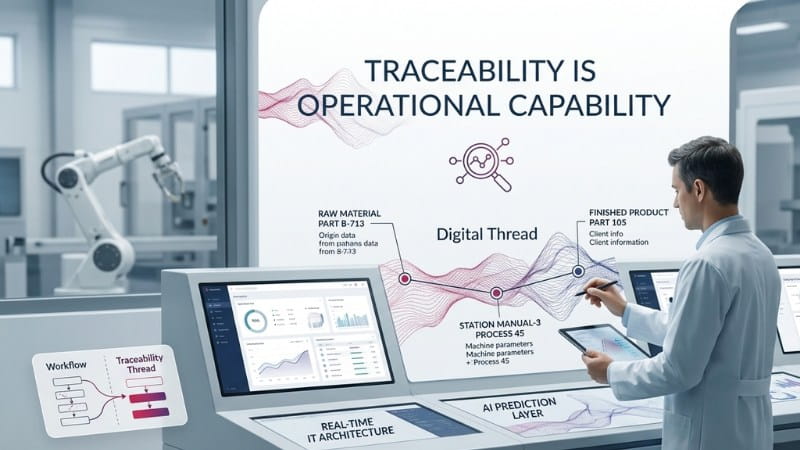
However, the key is that traceability is not just about recording data. Its true value emerges only when it allows you to connect three perspectives into one coherent picture:
- Component – its origin, parameters, batch,
- Process – production conditions, stations, operations,
- Final product – specific goods, series, customers.
Only such a combination enables a shift from reactive “firefighting” to conscious quality management.
Where does traceability most often fail?
The problem is rarely a lack of data. Many manufacturers have data but lack the ability to connect it. Information is scattered: some in ERP, some in Excel, some in isolated line systems. Even if you have access to all the data, correlating it in a crisis can be time-consuming and error-prone.
As a result, companies make decisions “just in case.” Instead of precisely narrowing the problem to a specific batch, they recall entire series of products, generating unnecessary costs and operational strain.
What does truly effective traceability look like?
Successful implementation of this capability is not about creating another layer of reports, but about building a data architecture that reflects the actual production flow.
In a well-designed solution, you don’t search through data manually. You indicate the component batch code and get an immediate answer: in which products was it used? Instead of hours of analysis, you have a decision in minutes. This allows not only for faster reaction but also for prediction – identifying irregularities before they translate into product quality issues.
Many projects end at the concept stage because they are implemented using methods from a decade ago. The traditional approach to software development in production is too rigid:
- Processes change over time, and rigid IT systems cannot keep up with this dynamic.
- Every modification requires involving external IT, which drastically extends response times.
From reaction to prediction
Implementing traceability changes how an organization reacts to quality problems. Analysis time is shortened, the risk of wrong decisions decreases, and actions become much more precise.
An even greater change, however, is the shift from reaction to prediction. Constant access to data on parameters and deviations allows irregularities to be identified earlier – before they affect product quality or lead to claims. In practice, this means not only lower claim costs but also greater stability of the production process and better control over its variability.
archITekt – the answer to production dynamics
This is where advanced low-code technology (like the archITekt platform) comes in. It allows for creating solutions perfectly tailored to the plant’s specifics, iteratively and quickly.
However, beware: not every low-code tool is suitable for the production floor. BPMS-class systems are great for invoice workflows, but they “choke” under the volume of production data. Production means thousands of events per minute, complex relationships, and the need for instantaneous searching of millions of records.
In a production environment, you need a tool that combines the flexibility of low-code with enterprise-grade architecture. In archITekt, this means:
- Performance
The system handles huge volumes of data without bottlenecking. - Natural relationships
Connections between components are baked into the solution’s “DNA,” not tacked on. - Adaptability
Instead of rebuilding the whole system, we adjust the data model to changing production.
When does traceability stop being an option?
Traceability is not a gadget for the chosen few. It becomes a foundation when:
- The number of dependencies (components, suppliers) grows.
- The costs of claims and defects start impacting the bottom line.
- Response time to errors has become a critical point in customer relationships.
Modern production is information management. Traceability links data, processes, and decisions into one ecosystem. Thanks to this, not only do you react to problems faster, but you start eliminating them at the source. In business practice, this translates into concrete results: greater control, lower costs, and a real competitive advantage.
Your production data should work for you, not be a burden that cannot be searched. Do you have the feeling that traceability in your plant is still just a “paper project”? Let’s talk about how to build an architecture that truly supports quality.