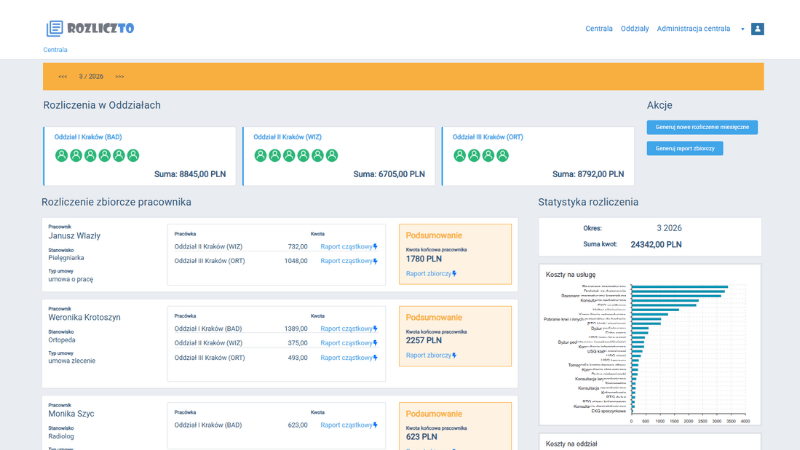

Monthly settlements for doctors and specialists often seem like a straightforward process. After all, all you need to do is count the services provided and calculate the compensation due. In practice, healthcare organizations operating across multiple facilities know that it is rarely that simple.
Every appointment, procedure, or hour worked by a specialist involves a series of administrative activities: recording the service provided, assigning the appropriate rate, verifying the data, approving the settlement, and, in the case of B2B cooperation, also handling accounting documents.
At a single facility with a small number of employees, such a process can be managed manually. The problem arises as the organization grows. When an organization works with numerous doctors and specialists across different locations, the number of data points, dependencies, and exceptions can quickly increase.
At that point, it becomes clear that the biggest challenge is not calculating the compensation itself. The real challenge is bringing together all the information required to calculate it correctly.
Stage 1. Building the Settlement Model
Every efficient settlement process starts well before the end of the month.
The foundation is defining the rules according to which the organization will settle the services provided. The first step is to determine which services are offered and how they are settled. Depending on the nature of the organization, compensation may be calculated based on hours worked, the number of services provided, or a fixed rate.
The next element is linking services to positions. Not every employee is authorized to provide all available services. The scope of services often depends directly on the employee’s position or qualifications.
Employees and contractors are then added to the process. In addition to personal details, information about the form of cooperation, position, and scope of services provided becomes important. If the organization operates across multiple locations, employees must also be assigned to specific facilities.
Only after all these elements have been connected can compensation rates be defined.
In practice, this means establishing relationships between:
employee → position → service → facility → rate
This is the stage at which the rules are created that later make it possible to automate settlements and reduce the risk of errors.
Stage 2. Processing the Monthly Settlement
Once the settlement model has been prepared, the actual operational process begins.
A new settlement period is created first. The facilities then provide information about the services performed.
The data may come from different sources. In some cases, it is entered manually; in others, it is imported from other systems.
The key point, however, is that the organization does not have to build the entire settlement from scratch every month.
Instead, it uses previously defined rules concerning employees, services, and rates.
Once the data has been entered, the verification stage begins. This is when the organization can check whether the information is correct, identify discrepancies, and confirm that all required data has been submitted by the facilities.
Only after this verification does the settlement move to the approval stage.
When working with a larger number of employees, the ability to monitor the status of individual settlements becomes particularly important.
Those responsible for the process need to know:
- which data has already been entered,
- which settlements are awaiting verification,
- which settlements have been approved,
- which ones require additional action.
Without this level of control, closing the month can quickly turn into a manual process of tracking information scattered across spreadsheets, emails, and documents.
Stage 3. Closing the Process
In many organizations, the settlement process does not end with compensation approval.
This is particularly relevant when working with doctors and specialists on a B2B basis. Once a settlement has been approved, the organization may still need to receive an invoice and link it to the appropriate settlement period.
Only then can the process be considered complete.
The final stage is reporting.
Reporting makes it possible to analyze data from different perspectives:
- a specific facility,
- a specific employee,
- a particular service,
- the organization as a whole.
Reports therefore become more than just a monthly summary. They can also provide information that supports business decision-making.
Why Treat Settlements as One End-to-End Process?
In many organizations, individual stages of the settlement process operate independently.
Facilities maintain their own spreadsheets. Rates are stored in separate files. Approvals take place via email. Invoices are stored in yet another system.
This model may work for a long time. The problem arises when the organization grows.
Every new facility, employee, and service increases the number of dependencies that need to be managed.
That is why it is worth looking at settlements not as a collection of individual tasks, but as one end-to-end process:
service delivery → data registration → calculation → verification → approval → document → reporting
Connecting all these stages gives the organization real control over the settlement process.
It helps reduce manual data processing, minimize the risk of errors, and close subsequent settlement periods more efficiently.
And the more facilities and employees an organization has, the more important it becomes not simply to calculate compensation, but to manage the entire process effectively.
This, however, is only the beginning of the challenges.
What happens when the same doctor works at several facilities at the same time, and each facility stores its own part of the data?
We will explore this challenge in the next article.