VeloBank automates financial health monitoring of business clients with a low-code platform
Discover how, by leveraging low-code technology and implementing an Early Warning System, VeloBank increased the scale of its business portfolio monitoring, reduced credit risk, and optimized operational processes — without expanding its analytical teams.
Project Overview

The dynamic growth of the business client portfolio required a new approach to monitoring financial health. Existing, partially manual processes had become insufficient — they were time-consuming, costly, and difficult to scale alongside the growing number of serviced entities.
The bank faced a strategic decision: increase the number of analysts, which would result in higher operational costs and limited scalability, or automate processes and implement a system enabling fast, systematic detection of early warning signals within the business client portfolio.
The bank chose automation. The objective was to build a flexible and scalable solution supporting risk management and decision-making based on up-to-date and reliable data.
Project Objectives
The goal of the project was to implement a comprehensive system enabling effective monitoring of business clients’ financial health and early identification of credit quality deterioration.
A key assumption was the automation of manual processes, allowing the bank to shorten analysis time, improve operational efficiency, and reduce the risk of errors. The solution was designed in a modular and scalable way, enabling further development in line with changing regulatory requirements and evolving business needs.
About the Client
VeloBank S.A. is one of the ten largest banks in Poland, offering a full spectrum of financial services — from retail banking and investment products to solutions for businesses and the public sector. The bank consistently invests in digital technologies that support both customer service and risk management.

Key Project Challenges
The project involved significant technological and organizational challenges.
Evolving Source Data Model
The solution had to be adapted to a dynamically evolving data structure.
Building a High-Quality Data Layer
Designing a consistent, structured, and reliable data architecture enabling advanced analytics.
Flexibility and Scalability
Designing a solution resilient to changing business needs and capable of supporting the organization’s future growth.
Integration with Multiple Systems
Ensuring seamless data exchange between the data warehouse, the Fraud Detection system, BIKP, Multiconnect, and Active Directory.
Implementation Process and Collaboration

Project Methodology
The project was delivered using the Agile methodology, in close cooperation between the teams of VeloBank and VSoft S.A. Work began with the development of an MVP, which allowed for quick validation of business and technical assumptions.
The system was then developed iteratively in two-week sprints, each concluded with a presentation of results and feedback collection from business users. This approach enabled continuous adjustment of functionalities to the organization’s real needs.
Before launching the solution, dedicated training sessions were conducted to ensure that the bank’s teams could independently use and further develop the system.
Technical Challenges
The most significant technical challenge was the changing data model and the need to maintain high data quality.
The use of the VSoft archITekt low-code platform enabled automatic data profiling after each change, allowing the team to quickly identify inconsistencies and respond to potential issues at an early stage.

The Solution
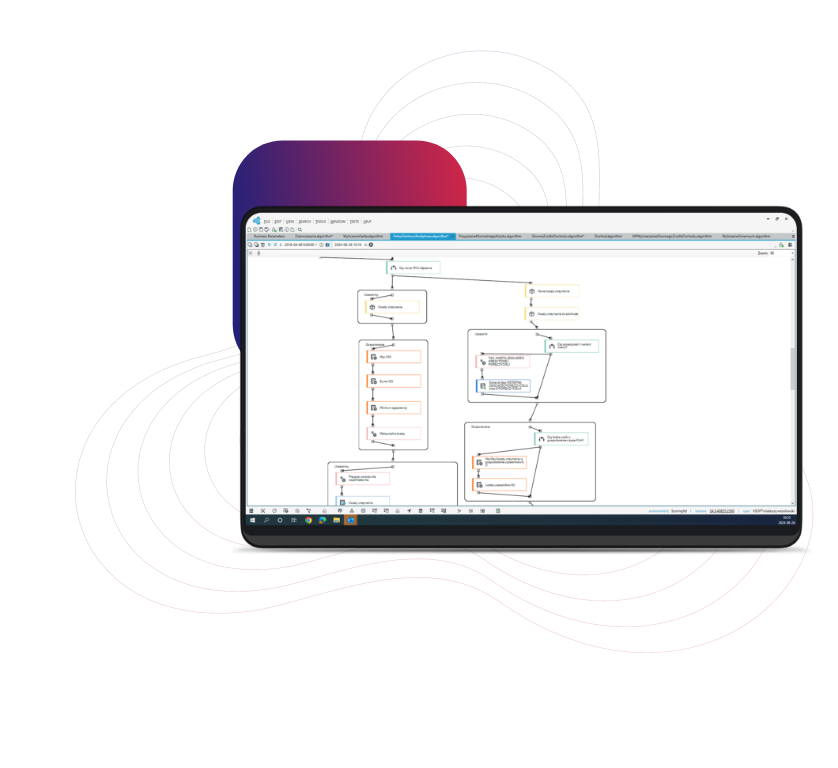
VSoft designed and implemented the VSoft Early Warning System — a solution built entirely on the VSoft archITekt low-code platform.
The system automatically analyzes clients’ financial data, identifies early warning signals, and supports banking teams in planning and executing remedial actions.
A key value of the system is the ability for further development on the bank’s side — without the need to engage the vendor for every modification.
„The Early Warning System delivered by VSoft S.A. met the Bank’s key technological and quality expectations. The applied low-code technology and VSoft archITekt platform enable further development of the system — it is scalable and open to subsequent modifications, which can be implemented both independently by the Bank’s employees and by VSoft S.A. upon request.”.
Results
As a result of implementing the Early Warning System, VeloBank achieved:
optimized operational processes and improved control over action execution
Key Takeaways
Project assumptions
- Close cooperation between VeloBank and VSoft S.A. teams at every stage was the foundation of the project’s success.
- The iterative delivery model enabled rapid functionality validation and early issue resolution before final deployment.
- The flexibility of the low-code platform allowed easy adaptation to evolving business and technical requirements.
Project Objectives
The project demonstrated that automating risk monitoring processes can significantly enhance a financial institution’s security while simultaneously reducing operational costs. The Agile methodology enabled rapid validation of functionalities and early elimination of issues. Leveraging the VSoft archITekt low-code platform provided the bank with flexibility, development independence, and the ability to quickly respond to business and regulatory changes.

Wacław Majka
Business Solutions Architect, VSoft S.A.