

A carbon footprint is no longer just a regulatory matter. Banks ask about it when financing large investments, business partners ask when selecting suppliers, and clients ask because they must report emissions across their own value chain. More and more companies therefore need a reliable answer expressed in CO₂ equivalent (CO₂e).
Calculating emissions, however, is not easy. The data is scattered across many places: energy and fuel invoices, fleet records, purchasing and transport summaries. On top of that come emission factors from various sources, updated every year. When everything is compiled in a spreadsheet, every change to a factor means fixing formulas, and the report is difficult to reproduce and defend before an auditor.
That is why, with ESG and non-financial reporting specialists in mind, as well as the finance and administration teams who supply the data, we have built a ready-to-use Carbon Footprint application on the archITekt low-code platform. It lets you collect emissions data and automatically convert it in line with the GHG Protocol approach.
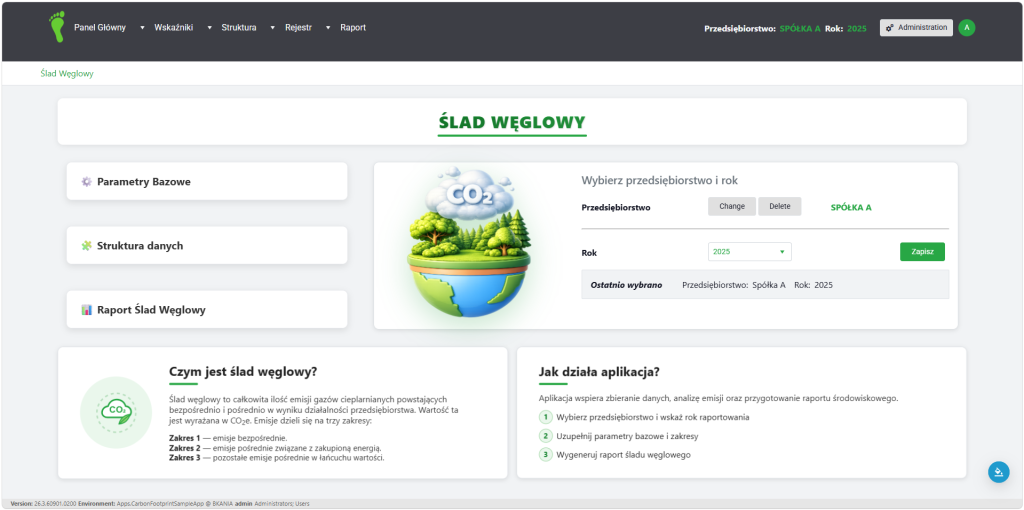
Key features
The application is used to calculate, monitor and analyze greenhouse gas emissions: from data collection, through conversion, to a ready report. In short:
- Emission factors from DEFRA, KOBiZE and other sources
- CO₂e emission calculation algorithms
- Decision tables
- Data statistics
- Carbon footprint report generation
CO₂e emissions calculated automatically
In practice, working with the application involves three steps, and the most labor-intensive one, the conversion, happens automatically.
Data in three scopes
The GHG Protocol divides emissions into three scopes. Scope 1 covers direct emissions, e.g. from burning fuel in your own boilers or fleet. Scope 2 covers indirect emissions from purchased electricity and heat. Scope 3 covers all other emissions in the value chain, e.g. from purchased materials or transport. In the application, data for all three scopes is collected in one place (for a selected company and year) and updated on an ongoing basis.
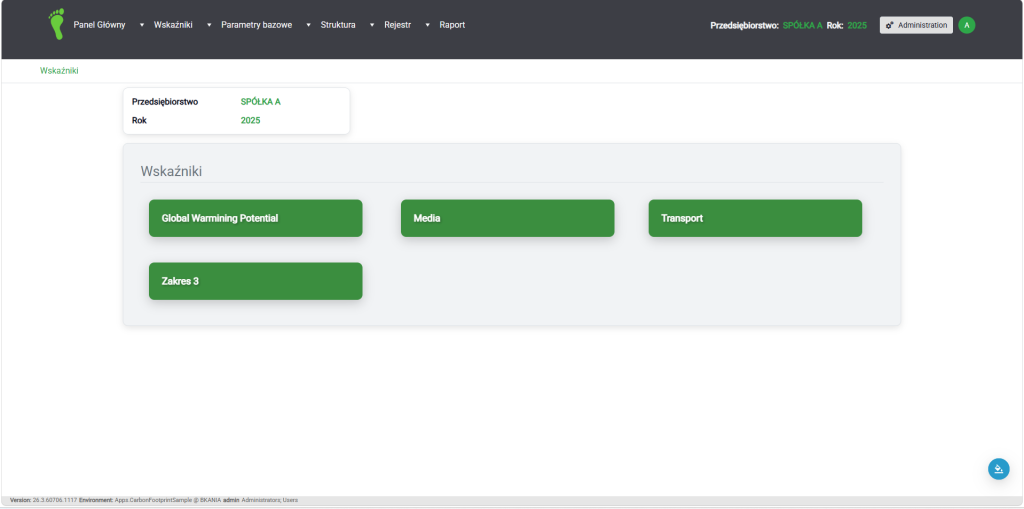
Conversion
The system automatically converts the entered data into CO₂ equivalent using emission factors from sources including DEFRA and KOBiZE. Calculations are handled by algorithms and decision tables, so the same data always produces the same result, and a new factor doesn’t require fixing formulas in ten different places.
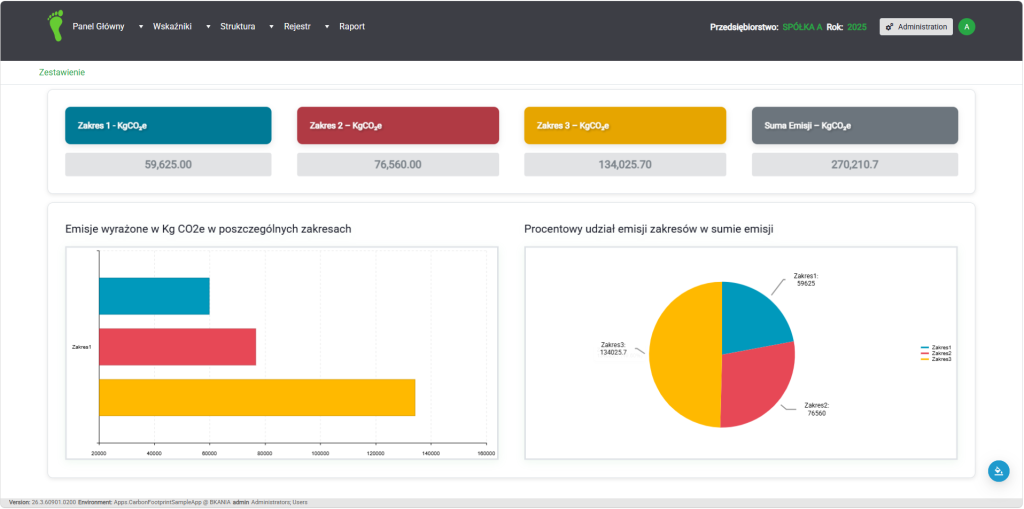
Report
Results are visible immediately in the statistics, broken down by scope. The carbon footprint report is generated in the application, ready to send to a bank, business partner or management board.
Emissions data still comes from many sources, but the result is produced in one place and according to one set of rules.
An application tailored to your rules
Carbon Footprint is a sample application: a working example and a starting point. It was built on the archITekt low-code platform, so emission factors, emission categories and conversion rules are stored in decision tables. When a new factor appears or your organization needs an additional category, you simply update the table, without rebuilding the application or developing a system from scratch.
Want to prepare your own carbon footprint report? Download the free archITekt demo and see how the platform works.
* Banner image generated using AI